Roots — Artvin
The story begins in the misted mountains of the Eastern Black Sea, in the foaming waters of the Çoruh, and in the weight of a kept word. To be born in Çifteköprü is to learn early the tempo of land, the visible return of labour, and that word and result stand together.
Where is Artvin?
Artvin sits in Türkiye's northeast, in the Eastern Black Sea section of the Black Sea Region, set in the deep and steep valley of the Çoruh River. To its east lies Ardahan, to the south Erzurum, to the west Rize; to the north stretch the Georgian border and the Black Sea's short, lonely coast. Forests cover roughly 55% of its area — one of the most densely forested provinces in Türkiye.
The Kaçkar (3,937 m) and Karçal (3.428 m) ranges meet the Çoruh's deep gorges to form a rugged land; beyond the Arhavi and Hopa flats there is no plain worth the name. Half the land is highland pasture. This geography shapes character: patient, measured, true to one's word.
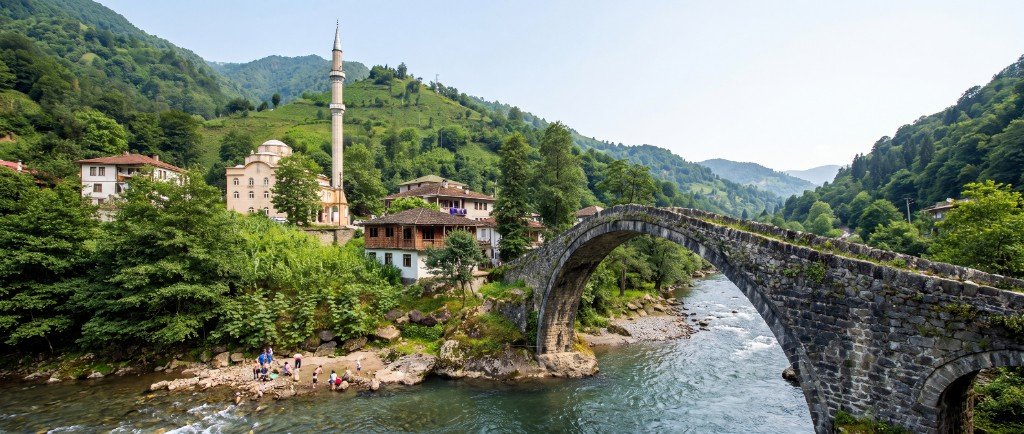
Çifteköprü and the Çhala valley
Çifteköprü is a mountain village in the Borçka district, on the banks of the Çhala stream. It is one of five villages of the Çhala valley; Fındıklı, Düzköy, Kale and Demirciler share the same slope, set near the river's source. The village's name comes from the Laz word Jurhinci, "two bridges"; its older names are Tskarka and Gola. Before 1970 it was a quarter of Düzköy, then became an independent village.
The Çhala stream, which joins the Çoruh, links the villages along the valley. Water, stone and bridge here are not only infrastructure; they are a measure of time and a symbol of the word. When a word is given, keeping it holds its meaning as long as the bridge stands.
Historic bridges
The bridges of the region carry the marks of the Eastern Black Sea's distinctive stonework. Near Ortacalar village in Arhavi, two adjoining arch bridges from the 18th century — built over the Kamilet and Soğucak streams, nearly perpendicular to each other — are known as the "Çifte Köprü" (Double Bridge). Masonry, cut stone laid with egg white; they have endured rain, wind and earthquake for centuries and were restored in 2003. The Ministry of Culture and Tourism listed them among Türkiye's 13 most magnificent bridges in "Witnesses of History: Bridges".
In Borçka, on the Çoruh, stands a steel arch bridge brought in 1930 from the Škoda works of Czechoslovakia — a 113-metre span, 15.75-metre arch rise. Riveted, with no concrete, it is the symbol of Borçka and part of the world's cultural heritage.
A many-layered history
Artvin's soil carries the trace of many civilisations — from the Hurrians and Urartians to the Cimmerians, Scythians and Taochs; to Georgian, Armenian, Byzantine, Seljuk and Ottoman layers. Copper axes found in Şavşat-Meşeli and Yusufeli-Demirköy date the settlement back to the Hurrian era. This layering creates a cultural variety that shifts from district to district, village to village.
Culture and character
The symbol of Artvin is the bull; the century-old bull-wrestling at the Kafkasör Culture and Art Festival is one of the city's oldest traditions. In the region the tulum, kemençe, drum, zurna and Hemşin kaval are played; weddings and highland feasts live in these sounds. Its people are Georgians, Hemşinlis, Turks and Laz — a multi-lingual, multi-cultural heritage at the meeting point of the Caucasus, Anatolia and the Black Sea.
Family and land
In the family that came from this village, the father was a respected farmer; the mother came from a rooted Laz family. Early mornings in the fields and the weight of a kept word at the dinner table shaped character. In Artvin, land is not only livelihood but a measure of time; "word" and "result" stand side by side — an extension of early discipline.
Opening to Istanbul
Leaving for Istanbul after secondary school opened the second act. The road that now reaches international investment is fed by the same root: respect for the land, a kept word, assets built for the long horizon. The line that runs from Çifteköprü to Istanbul sites, and on to the ports of Montevideo and Recife, is the branches of a single root.